
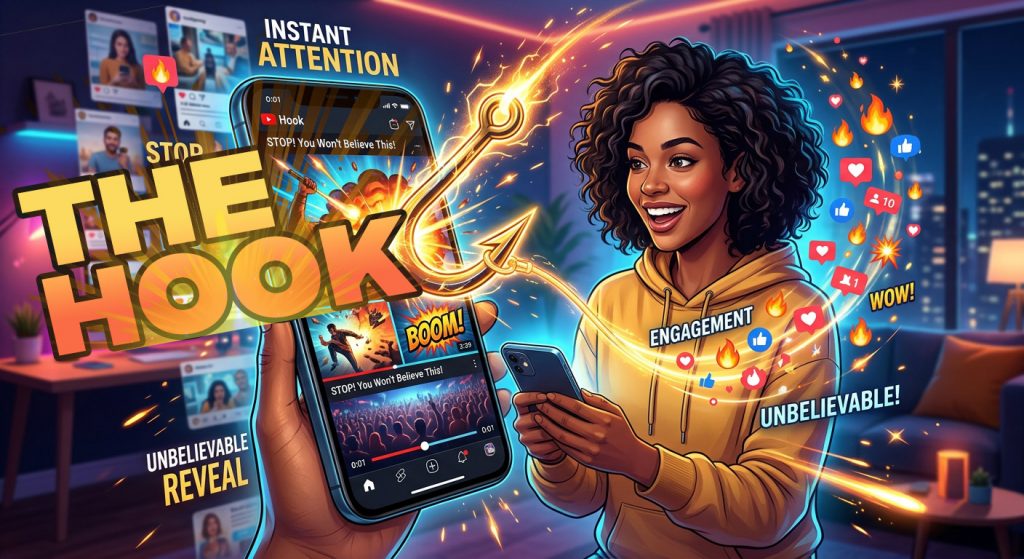
In the current landscape of digital media, your video is fighting against an infinite stream of content. If you aren’t capturing attention within the first few seconds, you have already lost the viewer. For professional video editors and content creators, the “hook” is no longer just an introduction; it is the most critical technical and creative decision in your edit.
The Psychology of the First Five Seconds
Human attention spans are shrinking, but more importantly, our “boredom threshold” is lower than ever. When a viewer clicks on your video, their brain is subconsciously asking: Is this worth my time?
A high-retention hook answers that question immediately by utilizing the Pattern Interrupt technique. A pattern interrupt is any sudden change in visual or auditory information that forces the viewer’s brain to reset and pay attention.
- Visual Interrupts: If your video starts with a slow fade-in, you are boring the viewer. Instead, jump straight into a high-impact movement, a jarring text overlay, or a close-up reaction shot.
- Auditory Interrupts: Start with the most dramatic line of the video, a sound effect that builds tension, or a clear, high-quality audio statement that sets the stakes of the story.
Anatomy of a Winning Hook
To build a hook that retains viewers, you must structure it using the “Identify, Provoke, Promise” framework:
- Identify: Call out the target audience or the specific problem they are facing.
- Provoke: Present the conflict or the stakes. Why does this matter right now?
- Promise: Clearly state what they will learn or experience by watching the full video.
Example: Imagine you are editing a documentary-style video about industrial history.
- Weak Hook: “Hello, today we are going to look at the history of oil extraction in South America and why it changed everything.” (This is a lecture, not a hook.)
- High-Retention Hook: [Visual: Close-up of a weathered map, fast zoom to a specific region] “In 1914, one single discovery made a nation instantly wealthy—and destroyed its economy in under a decade.” [Text Overlay: The Curse of Oil] “Today, we’re looking at why that happened, and the mistake we’re still making today.”
The “Technical” Side of Retention
As a professional editor, your tools are your primary means of keeping the viewer engaged. Using Adobe Premiere Pro, you can execute these strategies to maintain momentum:
- Tight Editing (J and L Cuts): Don’t let the visual and audio cuts happen at the exact same time. Use J-cuts (audio of the next clip starts before the video) to bridge transitions seamlessly, making the edit feel organic rather than jarring.
- The “Speed Ramp” Effect: When shifting between clips, especially in high-energy documentary content, use a subtle speed ramp. Starting a clip at 200% speed and settling into 100% gives the video a sense of urgency that signals to the brain that “important information is coming.”
- The “Text-Pop” Strategy: In the first 30 seconds, use dynamic motion graphics to emphasize key keywords. When your narrator says “instantly wealthy,” that text should appear on the screen, perfectly synced with the audio. This creates an extra layer of cognitive engagement.
Analyzing Your Own Data
Retention isn’t just about theory; it’s about data. If you are posting on YouTube or social platforms, look at your Audience Retention Graph. If you see a sharp drop-off in the first 10 seconds, your hook is likely too slow or fails to deliver on the title/thumbnail promise.
If you see a “plateau” where the retention is stable, you have succeeded. To improve, look for the moments where the line dips and ask: Did the pace slow down here? Did the music choice stop matching the narrative tone?
Putting It Into Practice
For your next project, treat the first 10 seconds like an independent, high-budget trailer. Do not worry about the “chronological order” of your story. Instead, take the best, most dramatic moment from the middle or end of your video, pull it to the front, and use it as your hook.
By prioritizing the “hook-first” mindset, you shift from being just an editor who cuts footage, to a storyteller who commands attention. Your goal is to make it impossible for the viewer to click away. When you master the hook, the rest of your video—the documentary segments, the technical deep dives, the beautiful B-roll—finally has the audience it deserves.
How do you currently structure your openings? Do you find yourself writing the script first, or do you start with the visuals? Let me know, and we can refine your specific hook strategy for your next documentary project!
Leave a Reply