
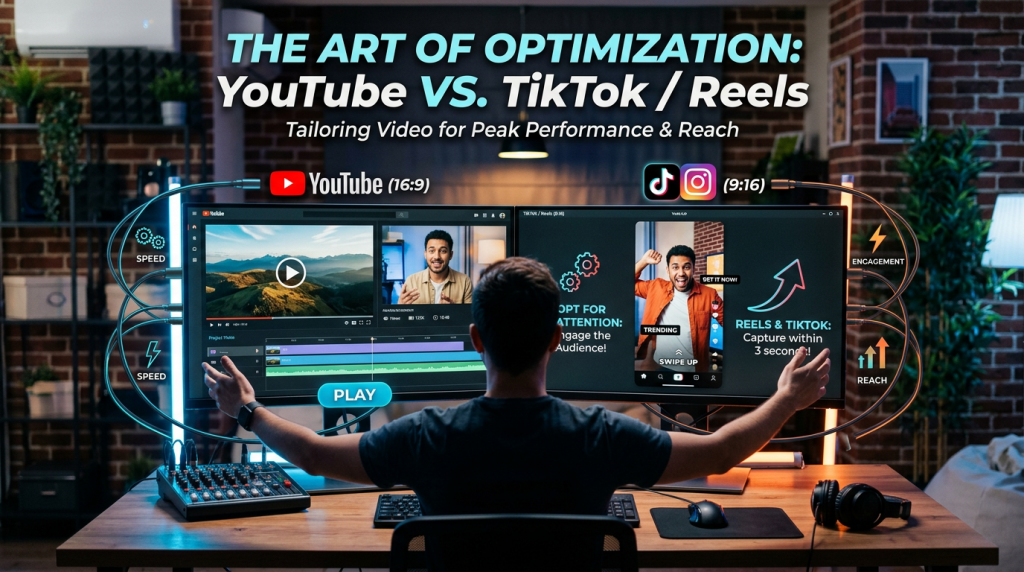
One of the most common mistakes I see editors make (even professionals) is treating every social platform as a “one-size-fits-all” environment. You might have a perfectly color-graded, beautifully paced documentary sequence for your YouTube channel, but if you simply crop that same video for a TikTok or an Instagram Reel, you are likely failing to capture the audience.
To grow your reach, you must understand the technical and psychological difference between long-form discovery and short-form consumption.
The Technical Divide: Aspect Ratio and Frame Rates
- YouTube (The 16:9 Landscape): This is your “cinema.” Viewers here are often in a learning or entertainment mindset and are willing to commit time to deep dives. Your technical focus should be on audio fidelity, high-resolution B-roll, and narrative flow.
- TikTok/Reels (The 9:16 Vertical): This is a “snack.” The viewer is likely swiping rapidly. Your technical focus here must shift to vertical composition, aggressive text-overlays, and immediate visual stimulation. When repurposing, don’t just “Center Crop” your 16:9 video, manually re-frame your shots so the subject remains the center of gravity in the 9:16 frame.
The Psychology of Consumption
- YouTube = Intentional Viewing: The audience comes to you for a specific reason. You have a “covenant” with them; if your thumbnail and title promise a deep dive into the history of an industry, they will watch 10+ minutes if the value is there. Your editing here should be deliberate—giving the viewer time to process information.
- Social Shorts = The Loop: TikTok and Reels rely on the infinite loop. The best short-form content doesn’t just “end”—it circles back. A great way to do this is to have your final sentence in the video seamlessly lead back into your first sentence. This creates a “looping” effect that tricks the viewer’s brain into watching the video twice, which is the single most powerful signal to the platform’s algorithm that your content is “high quality.”
My Repurposing Workflow: The “Anchor” Method
When I’m working on a large project, I don’t edit the YouTube video and the Shorts separately. I use the Anchor Method:
- Find the “Golden Nugget”: While editing your main documentary, identify the 30–60 second segment that holds the most intense emotion or the most surprising statistic.
- Vertical Re-framing: I pull that segment into a separate 9:16 timeline. I use Motion Graphics to add “captions” at the bottom (vital, as many people watch without sound).
- The Hook Injection: I strip the original intro and replace it with a high-energy hook designed specifically for the short-form feed.
- Audio Adjustment: Short-form audio needs to be mixed differently. Because people often listen on phone speakers, I boost the mid-range frequencies of the voice-over and ensure the background music is compressed so it doesn’t overpower the dialogue.
Why This Matters for Your Growth
If you are building an online editing business, your social media presence is your “portfolio.” A potential client isn’t just looking at whether you can cut a video; they are looking at whether you understand the platform. If you can show them that you know how to edit for the specific rhythm of a Reel and the deliberate pacing of a YouTube deep dive, you become an invaluable asset.
The algorithm doesn’t care about your hours of hard work; it cares about user retention. By optimizing for the specific expectations of each platform, you stop fighting the system and start working with it.
Are you currently repurposing your long-form videos into shorter content, or are you creating custom pieces for every platform? What is the biggest challenge you face when trying to adapt your editing style for vertical mobile screens? Drop a comment and let’s discuss the best way to scale your content!
Leave a Reply