
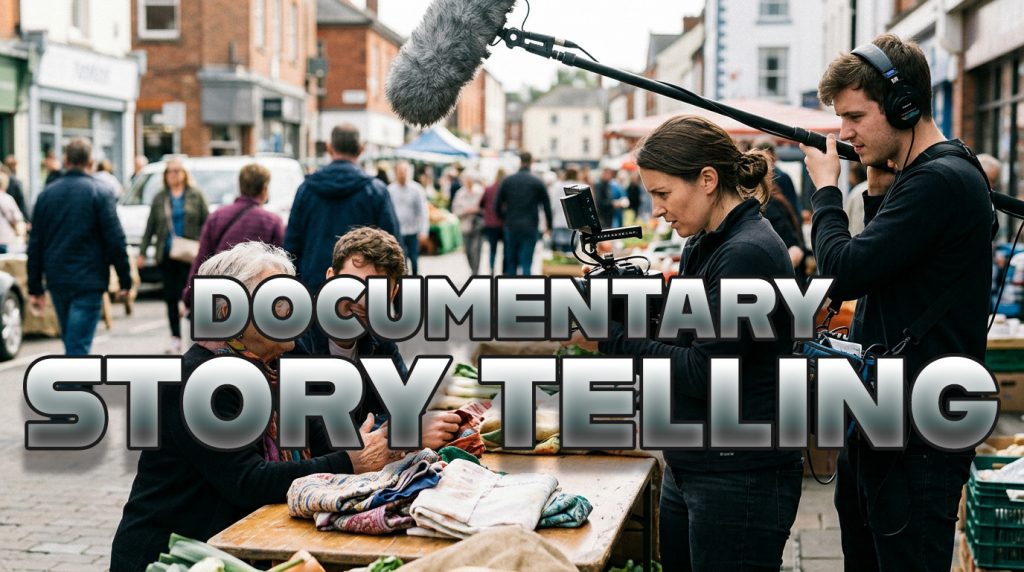
In professional video editing, the difference between a “supercut” of clips and a compelling documentary is the narrative structure. Many editors fall into the trap of letting the footage dictate the story—they organize clips chronologically and hope it flows. But as a professional storyteller, your job is to build an argument, evoke an emotion, or document a reality through a carefully crafted sequence.
The core of documentary-style storytelling is the relationship between A-Roll (the primary interview or dialogue) and B-Roll (the visual context). Mastering this balance is what separates a amateur project from a polished production.
The “Thematic Bridge” Technique
The most common mistake is using B-Roll merely to “hide” jump cuts. While this is technically necessary, it is a missed opportunity. Instead, use the Thematic Bridge technique. A thematic bridge uses your B-Roll to provide visual evidence or metaphorical context to the argument being made by the A-Roll.
If your interviewee is talking about the complexity of the oil industry in 1914, do not just show generic stock footage of oil rigs. Show specific historical documents, maps, or close-ups of machinery from that era. The visual should be a supplement to the verbal point, not just a band-aid for your cuts.
Structure Your Edit: The 3-Act Documentary Arc
Even in a 5-minute YouTube video, you should treat your edit like a documentary feature:
- The Inciting Argument : This is your hook. Introduce the subject, state the stakes, and present the “question” that the video will answer.
- The Exploratory Phase : Here, you weave in your expert interviews (A-Roll) with supporting facts. This is where you educate the viewer. Use B-Roll to pace the information; if the dialogue is dense, use slower, sweeping B-Roll shots to give the viewer’s brain a moment to process the information.
- The Synthesis : Bring it all back together. How does the information you provided change the viewer’s understanding of the topic? End with a strong, definitive statement that provides closure or a call to action.
Technical Tips for Narrative Pacing
As an editor, your timeline is your canvas. Here is how to keep the narrative tight:
- Pace by Breath: When editing A-Roll, don’t just cut at the end of a sentence. Look at the waveform. If your subject takes a breath, keep that breath in the audio track! Removing every breath makes the audio sound robotic and “fake.” The rhythm of natural speech is essential for human connection.
- The “Rule of Three” for B-Roll: Try to avoid showing the same type of shot twice in a row. If you have a wide shot of an oil refinery, follow it with a medium shot of a worker, then a close-up of a pressure gauge. This variation keeps the viewer’s eyes engaged and prevents the video from feeling static.
- Audio Depth: Your B-Roll should have its own soundscape. If you are showing historical industrial footage, incorporate subtle sound effects—a low-frequency hum, the clanking of metal, or ambient wind. This “layering” makes the story feel immersive rather than like a lecture.
Example: Constructing a Narrative
When I was working on my own documentary project regarding the socio-economic impact of industries, I found that the most powerful segments weren’t the ones with the most talking—they were the ones with the most silence.
I would set up a powerful quote from an expert, then cut to a 10-second sequence of B-Roll accompanied by music that swelled in volume. By letting the image “breathe” without voice-over, I allowed the audience to internalize the weight of the information. When the narrator returned, the viewer was refreshed and ready for the next point.
Bringing the Story to Life
Ultimately, your edit is a conversation with the audience. If you feel like your project is dragging, go back to your timeline and ask: What is the emotional point of this scene? If you can’t identify it, the clip probably doesn’t need to be there.
Great documentaries aren’t edited; they are sculpted. By removing the unnecessary and focusing on the thematic core of each scene, you transform raw footage into a story that resonates.
How do you handle your B-Roll selection—do you pick clips that match the script’s mood, or do you prioritize the visual quality? Let me know your workflow in the comments—I’m always looking to refine how I pair visuals with complex narratives!
Leave a Reply